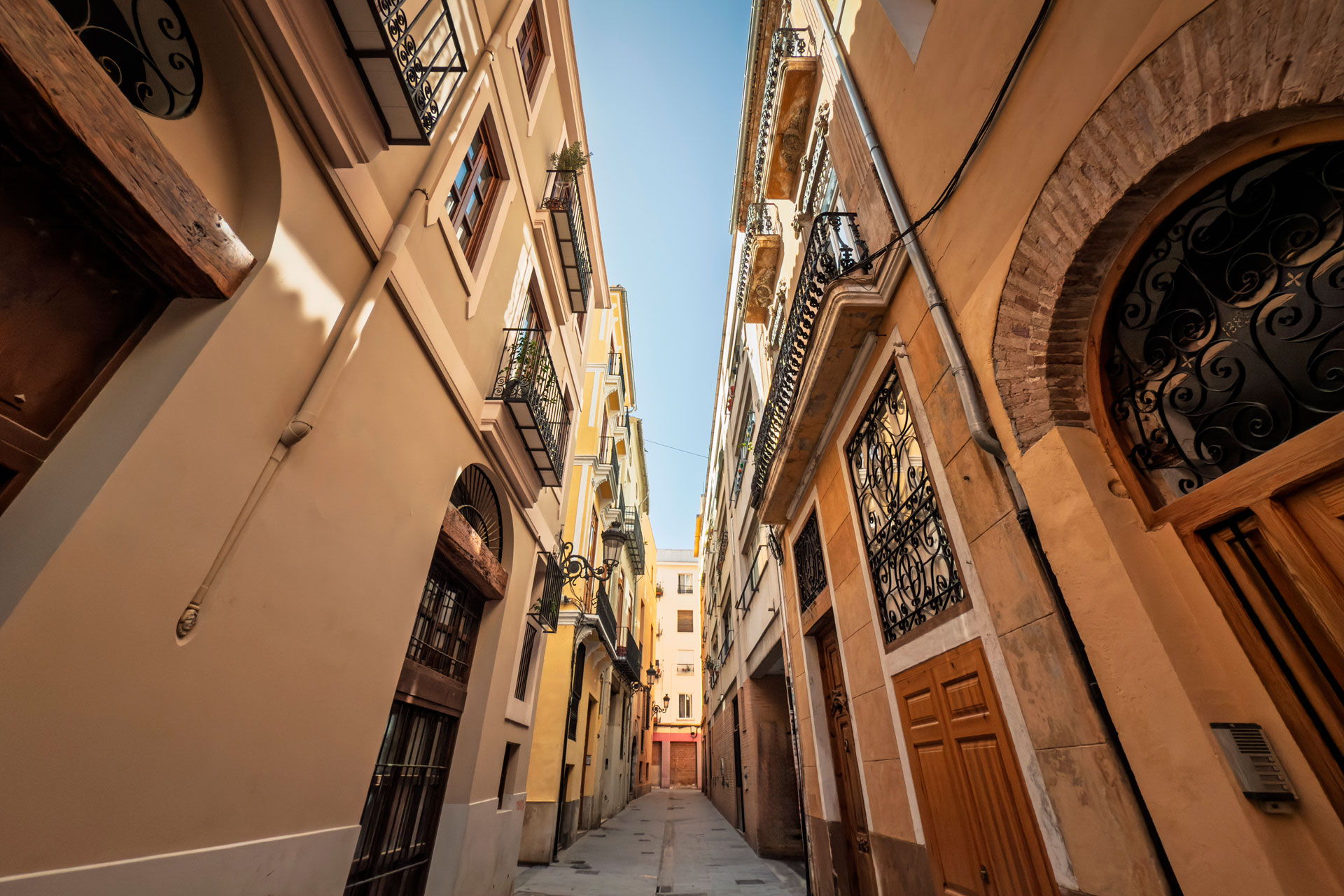

Somewhere between the second and third video call with most incoming clients, we tend to have the same conversation. The family has been sent Idealista links all week. They’re excited. They’ve found a beautiful apartment in Ruzafa with the vaulted ceilings, the herringbone floors, the wrought-iron balcony over the tree-lined street — the kind of place that photographs like a magazine spread. They ask, half-joking, whether we think it’s the one. And we ask, gently, whether they’ve thought about which direction the façade faces, whether there’s a patio-side bedroom, and what the persianas look like.
The look on their face is usually the same. It’s not a look we enjoy giving. But it’s the entire reason we do what we do. Valencia is one of the great walkable, liveable, family-friendly cities in Europe — and it also spends six weeks a year at 35-40°C, sometimes more. A property that photographs beautifully in January can be unbearable in July if it wasn’t designed for the climate it sits in, or if a previous renovation stripped away the two-thousand-year-old design tradition that used to make it liveable. The problem is that neither Idealista nor the average agent will tell you which is which. The photo is the same.
This article is what we wish every incoming buyer and tenant read before signing anything in Valencia. What traditional Valencia buildings do brilliantly to fight heat, why it works, what to look for on a viewing to tell whether a property has kept those features or lost them, what the comunidad de propietarios and the Ayuntamiento de Valencia will and won’t let you do to improve things after you move in, and where a well-planned renovation — using the current Next Generation EU aid still available in 2026 — can transform an imperfect property into a genuinely comfortable home. Some of the advice applies to owners planning to buy and renovate. Some applies just as much to tenants signing a long-term lease. All of it is the kind of thing that separates a home you’ll love in August from one you’ll spend August trying to leave.
Valencia is used to heat. The question is whether the property you’re about to sign for is used to it too. This piece is the technical companion to our 2026 buying property guide and our buying pitfalls article for buyers, and works alongside our renting pitfalls guide for tenants — because the questions you ask on a viewing are the same whether you’re buying or renting, and the answers matter just as much either way.
What traditional Valencia buildings do to keep you cool
Valencia has been figuring out how to survive summer for two thousand years, and the older buildings show it. Once you know what to look for, you can walk into an apartment and get a sense of how it’ll feel in August within about ten minutes. Here’s what actually makes the difference.
Thick walls. The late-19th and early-20th-century apartment blocks in Eixample, Ruzafa, Pla del Real and El Carmen were built with brick or stone walls 40 to 60 centimetres thick. Walls that thick absorb heat slowly during the day and release it slowly at night — meaning the inside of the flat stays several degrees cooler than the peak outdoor temperature, without any air conditioning. Modern renovations that replaced solid walls with lightweight partitions lose this. The apartment heats up in minutes and stays hot all night.
The patio de manzana. This is Valencia’s best-kept architectural secret and the single most important thing to look for. Every rectangular city block in the Eixample, Ruzafa and central Valencia is built around a big communal interior courtyard — the patio de manzana — surrounded by the backs of the buildings. Apartments have windows to both the street and this inner courtyard. The courtyard stays much cooler than the street, and that difference creates a natural draft: cool air flows in from the patio-side windows, hot air rises and escapes through the street-side windows. An apartment with functional cross-ventilation between street and patio de manzana is dramatically cooler in summer than one without — sometimes by 4 to 7 degrees, without a single watt of electricity.
Persianas. Those green or brown roller blinds you see on every façade in Valencia aren’t just aesthetic. They block the sun before it hits the window, which is the most effective way to stop heat entering a room. Closing the persianas on the sunny side while opening those on the shaded side is how every Valencian grandmother has cooled her flat for a century, and it still works. The catch: fully-closed persianas also block airflow, so during the hottest hours you have to choose between blocking the sun and getting a breeze. The classic slatted persianas that can tilt for airflow while still blocking direct sun are the best of both worlds.
Light colours. Traditional Valencia façades were painted white or pale ochre, and interior floors used the famous cobalt-and-green mosaico hidráulico tiles. These weren’t just pretty — light and cool-toned surfaces reflect a lot of the sun’s heat rather than absorbing it. That’s why modern renovations that go all-in on dark grey floors, black window frames and charcoal walls look striking in photos but bake in July.
Attic buffer on top-floor apartments. Traditional Valencia townhouses had an upper storage attic — the cambra — that acted as a heat buffer between the roof and the living space below. Modern top-floor apartments without that buffer, or without proper roof insulation, turn into greenhouses. If you’re looking at an ático (top-floor unit), the roof situation matters more than almost anything else.
What to look for on a viewing
Whether you’re buying or renting, here’s what we look at when we walk through a Valencia property with a client. Some of these you can check before you even visit; others need a viewing. All of them are things you can ask the agent or landlord directly — and the way they answer often tells you as much as the answer itself.
Which way does it face? South and west-facing façades take a beating in Valencia summers, especially west-facing ones between 3pm and sunset. North and east-facing façades stay dramatically cooler. Falling in love with the January light on a west-facing living room is a common way to end up sweating through July. Google Maps’ 3D view answers this in ninety seconds if you’re viewing remotely.
Does it have cross-ventilation? This is the single most important question. Are there windows on at least two different sides of the apartment — ideally one to the street and one to the patio de manzana? An apartment where all the windows are on the same wall can’t cross-ventilate at all, no matter how many windows there are, and it will always struggle in summer.
How high are the ceilings? Traditional Valencia apartments have ceilings of three metres or more, which lets hot air rise above head height. Modern renovations often drop ceilings to save on air-conditioning bills — but the trade-off is that the room feels warmer at seated height.
What are the windows like? Old single-pane wooden windows leak heat in every direction. Modern double-glazed windows with proper frames make a big difference. You don’t need to be a specialist to tell — if the windows feel flimsy, single-pane and rattle in a light breeze, the property will run hot in summer and cold in winter.
If it’s a top-floor apartment, what about the roof? Top-floor units are wonderful for light, terraces and views — but they take the full force of the summer sun through the roof. If the roof is insulated (or better, painted a light colour), a top-floor flat can be genuinely lovely. If it isn’t, it can be brutal in August. Ask.
What colour is everything painted? Dark walls, dark curtains, dark floors — they all absorb heat and release it back into the room. Lighter is cooler. Easier to change if you own; worth noting either way.
Is there air conditioning, and does it actually work? “Aire acondicionado” on a listing can mean anything from a proper installed split system to a portable unit left in a corner. Ask specifically what type it is, when it was last serviced, and — if you’re renting — whether it’s part of the rental or your responsibility. Many Valencia rentals include working AC as a standard feature; some quietly don’t.
The good news for tenants is that most of these questions are free to ask, and the answers won’t change once you’ve signed. The good news for buyers is that many of the trickier features can be improved after purchase, some cheaply and some with the significant renovation aid still available in 2026.
What the rules will actually let you do in 2026
This is where Valencia has become genuinely stricter in the last two years, and where a lot of well-intentioned improvements can go wrong. The short version: for anything that affects the outside of your building, you generally need two things — your community of owners has to approve it, and the City Council has to allow it. Both matter. Neither substitutes for the other. One important framing point before we go into the specifics: everything in this section is a decision the owners of the building make together. If you’re renting rather than owning, none of the community-level decisions are yours to raise or vote on. This section is worth reading anyway, so you understand what’s happening around you and what your landlord may or may not be able to change — but the actions themselves sit with the owners.
Air conditioning on the front of the building. In Valencia specifically, this is now essentially off the table. The City Council requires the outdoor AC units to sit on the rooftop or on the interior side of the building (facing the patio de manzana) — not visible from the street. Even if your community of owners votes in favour, the City Council’s rule takes precedence. If you’re buying a property that already has AC installed and approved, you’ve inherited an asset. If you need to install one from scratch, expect to put the unit on the patio side or the roof, and to run it past both the community and the ayuntamiento.
The good news is that early 2026 brought a change to Spanish community-of-owners rules that made it much easier to get things approved when they improve the building’s energy performance. Where before you’d have needed a large qualified majority of your neighbours to vote yes on things like insulation, solar panels or shared AC systems, now a simple majority is enough. That’s a real difference — proposals that would have been dead on arrival a year ago now genuinely have a chance.
Solar panels. For owners, small plug-in solar panels for a single balcony are usually allowed for personal use without much fuss. Anything larger, or anything visible from the street, needs community approval. Shared rooftop solar for the whole building is now much more approachable thanks to the 2026 rule change, and it’s worth raising at your community meeting if the roof is suitable.
Awnings, blinds and pergolas. Communities generally want to preserve a consistent look on the façade, which usually means a standard colour and style of toldo. Awnings on private terraces facing the inner courtyard are usually easier to get approved than street-facing ones. Adjustable outdoor louvres — the modern equivalent of persianas — are increasingly popular and generally approvable as long as they respect the overall look of the façade.
Painting the roof white. This is one of the highest-return things a community can do together, and almost nobody does it. A dark or terracotta roof soaks up heat all day and radiates it into the top-floor apartments and the whole building below. A white or reflective coating on the roof reflects most of that heat back into the sky, and can bring the top-floor peak temperature down by several degrees. It’s cheap (usually €10-25 per square metre), and under the 2026 rules a simple majority of the owners’ community can approve it. If you own a top-floor apartment in particular, it’s genuinely worth putting on the agenda at your next community meeting.
Repainting the façade a lighter colour. More complicated. Historic buildings in central Valencia often have their colour protected by heritage rules, so you can’t just repaint. In non-protected buildings, the community of owners can vote to lighten the façade for practical reasons, but this usually needs an architect’s proposal and a municipal permit.
What you can do to make the place cooler, once you’re in
Once you’re living in a Valencia property — whether you’re renting or you’ve just bought — a handful of small and larger improvements can transform how the place feels in summer. Here’s the honest hierarchy, from what a tenant can do this weekend to what an owner or a whole community can plan properly.
If you’re renting (nothing your landlord needs to approve):
- Use the persianas properly. This sounds obvious but most incoming residents don’t. Close them on the sunny side of the flat from mid-morning until the evening; open them in the cool early morning and after sunset. Open the windows behind them at night to let the cool air flow through. A single summer of doing this well beats any hardware change.
- Add reflective blackout curtains behind the windows on the sunny side. A €40 pair on a west-facing window can drop the room temperature noticeably.
- Get a ceiling fan or a couple of good pedestal fans. Fans don’t cool the air, but they make you feel several degrees cooler by moving it — at a fraction of the electricity cost of AC. A pedestal fan pointed at an open patio-side window on a summer evening does more than most people expect.
- Move the bed and the desk away from west- and south-facing walls, which stay warm well into the night.
- Ask the landlord about installing (or servicing) AC if there isn’t one, or if the existing unit hasn’t been touched in years. A neglected AC unit uses far more electricity than it should. If the landlord agrees to install one, they usually pay because it improves the property; if you’re paying, get the arrangement in writing.
If you own (and don’t need anyone else’s permission):
- Restore the persianas properly if they’re broken, cracked or missing. This is the single highest-return fix in most older Valencia apartments.
- Replace old single-pane windows with modern double-glazed ones. Around €400-€800 per window, and eligible for a Next Generation EU grant of up to €3,000 per apartment (see below).
- Restore or add insulation on internal walls where a previous renovation stripped away the thick original walls.
- Repaint interiors and swap floors for lighter colours. Cheap, and it changes how the space feels in July.
- Add ceiling fans — high ceilings in traditional Valencia apartments make them transformative.
- Install a proper split-system AC with the outdoor unit on the patio side or the roof (see the rules above). Modern units are almost silent and use surprisingly little electricity if properly sized.
If your community can be persuaded to work together (owners only — tenants can’t propose or vote on these):
- Insulate and paint the roof white. The single highest-return community project, and much easier to get approved under the 2026 rules. Big savings on top-floor comfort and everyone’s electricity bill. Often eligible for major renovation grants.
- Add exterior insulation to the whole façade. Bigger project, higher cost, but transforms the building for winter heating as well as summer cooling. Grant-eligible.
- Install shared rooftop solar. Runs the building’s lifts, lighting and water pumps, and can offset a chunk of everyone’s electricity bill. Simpler to approve than it used to be.
If you’re renting rather than owning, these community-level improvements aren’t yours to propose — only owners can raise motions at the community meeting or vote on them. What you can do, if you happen to have a particularly engaged landlord, is mention the ideas to them; but any conversation with the community itself has to come from an owner. Focus your own efforts on the tenant-level improvements above, which genuinely can transform how a place feels in summer.
A quick word on renovation grants. The Next Generation EU renovation aid is still available in 2026 and it’s substantial. For a single apartment, you can get around €3,000 back on energy-efficiency improvements. For a whole-building renovation that meaningfully improves energy performance, grants can cover 40-80% of the total cost. On top of that, you can usually deduct a good chunk of what you paid out-of-pocket from your annual tax return. Valencia city also gives significant discounts on the construction tax for energy-efficient renovations, and a few years of reduced property tax if you improve the building’s energy rating. It’s genuinely worth it — but it requires proper paperwork before, during and after the work. This is exactly the coordination our renovation management service handles.
The 2026 Next Generation EU renovation aid landscape. For individual apartments, the Generalitat Valenciana offers up to €3,000 in grants (approximately 40% of costs) for individual energy-efficiency improvements — thermal-break windows, interior insulation, efficient heating and cooling systems. For entire buildings, subvention rates run 40% to 80% of the total cost when the intervention achieves at least a 30% reduction in primary energy consumption. Some vulnerable-family scenarios can push aid to 100%. On top of Next Generation grants, up to 60% of the remaining out-of-pocket cost may be deducted from personal income tax (IRPF) under the current framework. The current call closes 27 February 2026, with a new cycle expected to follow. Valencia city also offers a 50-95% bonification on the ICIO (construction tax) for energy-efficient renovations, and IBI (property tax) reductions of 3-5 years for buildings that improve their official energy rating.
How we work with buyers and tenants, plainly
When we work with a family or an individual looking at Valencia properties, one of the first things we help with is filtering out the places that will be miserable in summer before you fall in love with them. For buyers, we screen properties for the heat-related red flags before you visit — orientation, cross-ventilation, roof condition, window quality, whether the traditional features are still there or have been renovated away. For tenants, the same screening happens as part of the housing search, because signing a five-year lease on a west-facing apartment with sealed windows is a five-year mistake, and catching it before you sign is the whole point.
When a renovation is on the table — either because you’re buying with improvement in mind, or because you already own a Valencia property that needs work — our renovation management service coordinates the architects, contractors and legal partners in our vetted network. The technical and legal work runs through those professionals, who bill you directly at their own rates. What our package covers is the coordination work around it: keeping the different parties talking, handling the community-approval process and the municipal permits, running the grant paperwork, and making sure the energy certifications line up so the aid you’re entitled to actually comes through at the end.
Start the conversation
If you’re seriously considering a Valencia property — buying or renting — a fifteen-minute conversation about the specific thermal profile of the properties you’re looking at, and the realistic short-list of things you can do to make the right one comfortable, is often the single most useful conversation of the whole process. We offer it for free, by video, no pitch.
Book your free 15-minute consultation here →
Valencia has been fighting the heat successfully for two thousand years. The properties that respect that tradition are extraordinarily liveable. The ones that don’t are what turn a beautiful listing photo into a summer regret. Helping you tell the difference, before you sign, is what we do.
Frequently Asked Questions
1. Can I install an air conditioner on the front of my Valencia apartment? In practice, no — not on the street-facing façade. Valencia City Council requires the outdoor AC unit to be placed on the rooftop or on the interior side of the building facing the patio de manzana, not visible from the street. Even if your community of owners votes in favour, the City Council’s rule takes precedence. Installing on the façade regardless can lead to being ordered to remove the unit and municipal fines. If you’re buying a property with AC already installed and properly approved, you’ve inherited an asset.
2. What is a patio de manzana and why does it matter for summer? The patio de manzana is the large interior courtyard that sits at the centre of every city block in Valencia’s Eixample, Ruzafa and central districts. It’s the single most important passive-cooling feature of traditional Valencia apartments. The courtyard stays cooler than the street, and that difference creates a natural draft that pulls fresh air through apartments with windows on both sides. Apartments with windows only on the street side lose this benefit entirely and always run hotter in summer.
3. What changed in early 2026 for AC and solar installations? Since January 2026, it’s become much easier for owners to get community approval for anything that improves the building’s energy performance — insulation, solar panels, shared AC systems, cool roofs. Where you used to need a large majority of neighbours to vote yes, now a simple majority is enough. That’s a real difference for anyone who owns and is thinking about proposing energy improvements at their community meeting. (For tenants, these community-level decisions still sit entirely with the owners of the building, so this change doesn’t affect what a tenant can push for directly.)
4. Can I put a solar panel on my balcony or terrace? If you own the apartment, small plug-in panels for personal use are generally fine and don’t need much red tape. Anything larger, or visible from the public street, needs community approval. Shared rooftop solar for the whole building is now much easier to get approved than it was a year ago, and it’s worth raising at your community meeting if you own and the roof is suitable. If you’re renting, you’ll need your landlord’s explicit consent before installing anything — even a small balcony panel — and shared rooftop solar isn’t a conversation tenants can bring to the community themselves.
5. Can I ask my community to paint the roof white? If you’re an owner, yes — and it’s one of the highest-return things a community can do. A white or reflective coating on the roof reflects most of the sun’s heat back into the sky instead of soaking it into the top-floor apartments below. On a typical Valencia building, it can drop the top-floor summer temperature by several degrees and cut the building’s cooling bill meaningfully. It’s not expensive to do, and under the current 2026 rules a simple majority of owners can approve it. If you own a top-floor apartment in particular, it’s worth putting on the agenda at your next community meeting. If you’re renting, this isn’t a proposal you can bring to the community yourself — only owners can raise motions or vote — but it’s a fair thing to mention to your landlord if you have that kind of relationship.
6. What renovation grants are actually available in Valencia in 2026? Quite a lot, actually. For an individual apartment, you can get up to €3,000 back on energy-efficiency improvements (new windows, insulation, efficient heating and cooling). For a whole-building renovation that genuinely improves the building’s energy performance, grants can cover 40-80% of the total cost. Plus you can typically deduct a good chunk of what you paid from your annual tax return. Valencia city also offers discounts on the construction tax for energy-efficient work and a few years of reduced property tax if the building’s energy rating improves. It adds up — but only if the paperwork is done properly, which is why most people work with a coordinator on this.
7. What’s the single most important thing to check on a viewing if summer heat matters to me? Cross-ventilation. Does the apartment have windows on at least two different sides — ideally one to the street and one to the patio de manzana? An apartment where all the windows are on the same wall can’t cross-ventilate, and it will always run hot in summer regardless of AC. Also check which direction it faces (west-facing without shade is the worst), whether the persianas work properly, and — if it’s a top-floor unit — the state of the roof.
8. Are traditional Valencia buildings really cooler than modern ones? Often yes, if the traditional features are still intact — thick walls, high ceilings, working persianas, cross-ventilation, and light-coloured surfaces. A well-preserved older Valencia apartment can be genuinely comfortable in summer without much AC use. But a badly-renovated older apartment — where the thick walls were replaced with thin partitions, the ceilings were dropped, and the cross-ventilation was blocked — is often worse than a properly-built modern one. It depends much more on the renovation quality than on the age.
9. Is exterior wall insulation on the façade worth doing? For owners in south- and west-facing buildings that take the worst afternoon sun, yes — it can cut heating and cooling bills significantly. For shaded or north-facing buildings, less dramatically so. It’s a bigger project that requires community approval and a municipal permit, so it’s a decision the community of owners makes together, not something an individual owner (and certainly not a tenant) can push through alone. When it’s combined with roof insulation and better windows as one integrated renovation, it’s typically eligible for the highest tier of Next Generation EU grants. Whether it makes sense for your specific building is a conversation worth having with an architect who knows the local aid framework.
10. What does Livin’Valencia actually do to help with heat-conscious buying and renting? Two things. When you’re buying or renting: we screen properties for the heat-related red flags before you visit them, look at things like orientation and cross-ventilation, and flag apartments where signing (or renovating enough to make them comfortable) would be a mistake — because catching that before the arras or the fianza is paid is what protects you. When a renovation is on the table: we coordinate the architects, contractors and legal partners in our vetted network, who bill you directly at their own professional rates, and handle the coordination work around it — community consent, municipal permits, grant applications, energy certifications and the paperwork for your tax return. We don’t take commission from sellers, landlords, contractors or architects — our clients pay us, which is what keeps our advice independent.
Have a question we haven’t covered? Get in touch → — we read every message.