
The moment we decided to move our own family of five to Valencia, the questions arrived faster than the answers. Which neighbourhood would feel right for the kids? Which school would actually welcome them in mid-October? Would the visa hold up? Could we afford the life we were imagining? If you are reading this, you probably know that particular mix of excitement, doubt, and quiet, late-night spreadsheet sessions.
We built Livin’Valencia precisely because we remember how steep the curve felt at the start. This guide is what we wish someone had handed us back then: the way family relocation to Valencia actually works in 2026, told plainly, with the parts the brochures tend to skip — neighbourhoods, schools, visas if you are non-EU, the administrative spine of the move, and where a local team genuinely earns its keep.
Why Valencia, and why families keep choosing it
Valencia is consistently ranked among the best cities in the world for expats, and the reasons hold up once you live here. The Mediterranean climate is genuine, the city is compact enough that the school run, the market, the pediatrician and the beach all sit within twenty manageable minutes, and healthcare is excellent in both the public and private systems. Streets feel safe at night in a way that surprises many North American parents in particular. The cost of living, even after recent rises, remains noticeably softer than Madrid, Barcelona, Paris, London, or any comparable US city.
For families, though, the deeper appeal is harder to quantify. Children play outside until late. Restaurants welcome them rather than tolerate them. The social fabric tilts toward the multigenerational, and you begin to notice that your kids are walking more, complaining less, and going to bed sun-tired. That is the part nobody puts in a relocation report.
Choosing the right neighbourhood for your family
Valencia divides into 19 districts and 88 neighbourhoods, and the right one depends almost entirely on the age of your children and the kind of daily life you want. Families gravitate toward four very different profiles.
If you want the calm of a leafy, residential area inside the city, Pla del Real is the postcode many expat families dream of. It sits across the Turia Gardens from the historic centre, it is one of the safest and quietest districts in Valencia, and it is walking distance to the Viveros Gardens and several well-regarded private schools. L’Eixample, particularly the sub-neighbourhood of Pla del Remei around the Mercado de Colón, offers a similar polished feel with a more urban, café-lined energy.
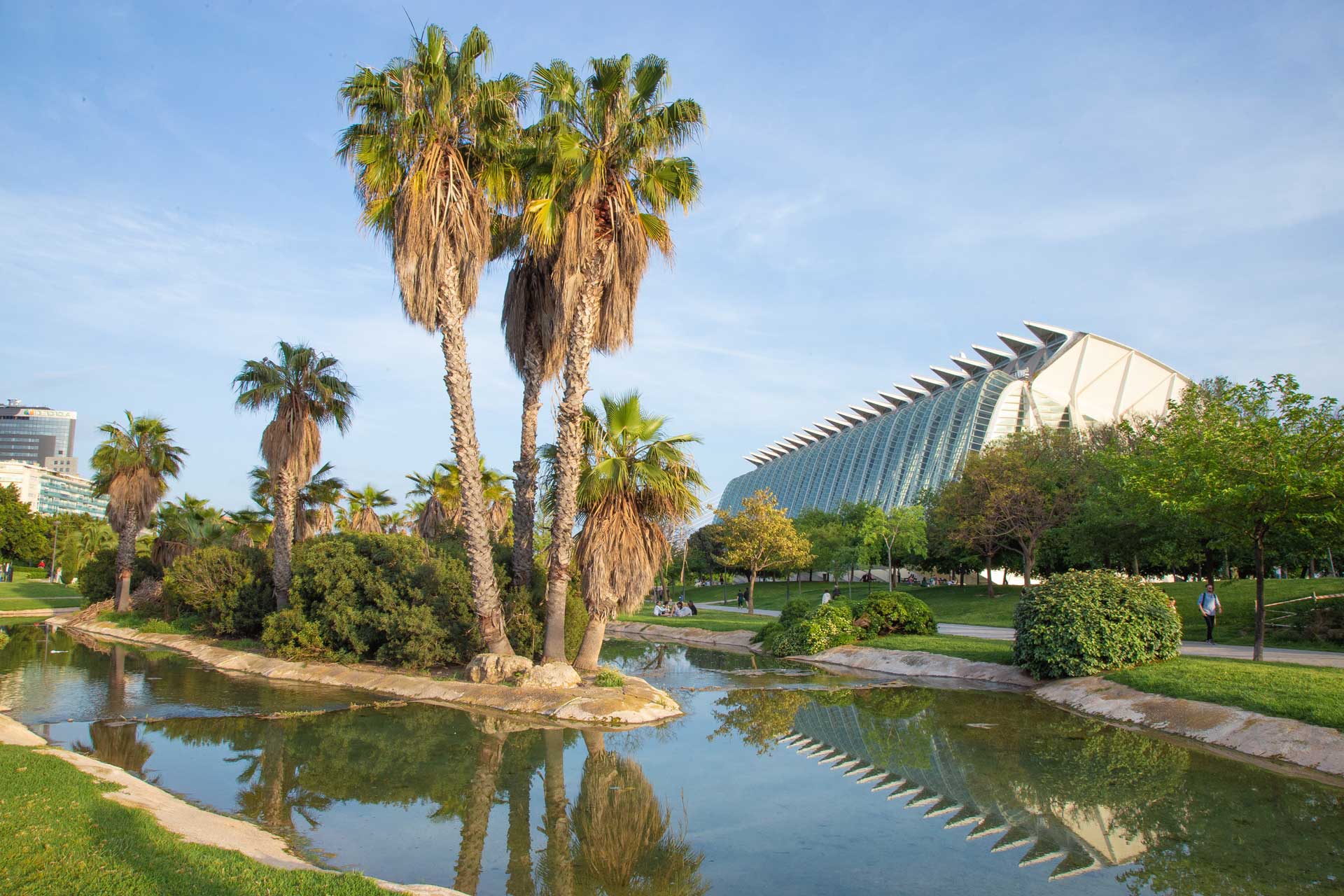
If you want green space, modern apartments with communal pools, and a more suburban rhythm without leaving the city, look closely at Campanar and Nou Campanar. Bordering the Turia Park, with good metro access and a strong reputation for family safety, this is the neighbourhood many families choose once they see it. The newer Avenida de Francia and Penya-Roja area, near the City of Arts and Sciences, plays a similar role on the eastern side, almost equidistant from the centre and the beach.
If you want a village-inside-the-city feel, Benimaclet is consistently one of the most loved neighbourhoods among long-term expat families. Patraix offers something similar at a lower price point, with strong public schools and a Spanish character that families wanting genuine immersion will appreciate.
If you want space, a garden, and easy access to the international schools, the conversation moves to the western suburbs. La Cañada, L’Eliana, Rocafort, Godella and Campolivar (part of Godella) are the names you will hear most often — quiet, leafy towns fifteen to twenty-five minutes from central Valencia, well connected by metro, and home to a strong cluster of international and bilingual schools.
This is where on-the-ground knowledge matters most. Listing photos rarely reveal whether a street is noisy at night, which buildings have a working lift, where the morning school-run bottleneck forms, or which apartment blocks have neighbour communities that welcome new arrivals. Our family relocation packages exist for exactly that translation — from postcode to lived experience.
Schooling in Valencia: the four lanes, and which one fits
The Spanish school system runs from optional preschool at age 3, through compulsory primary and secondary (ages 6–16), and on into bachillerato. Families have four real options, and the right one depends on your timeline, budget, your children’s ages, and whether you plan to stay long-term.
Public schools (colegios públicos) are free, of generally good quality, and follow the Spanish national curriculum, with instruction primarily in Spanish and, in the Comunidad Valenciana, in Valencian. They are allocated by catchment area, which is why your choice of home and your choice of school are genuinely the same decision.
Charter schools (colegios concertados) are privately run but partly state-funded, charging modest monthly fees for what is often a more structured environment, frequently with stronger English programmes and, in some cases, a religious affiliation. Demand is high and places are competitive. For children under roughly age ten, charter school is often the most powerful integration tool we have ever seen: within a year, most are functionally bilingual and have local friendships that will outlast the relocation itself.
Private Spanish schools offer smaller classes and full Spanish-language immersion at private-school fees. International schools — British, American, French, German, IB — cluster in and around the western suburbs, with names families ask about most including the British schools of the L’Eliana–Rocafort–Campolivar belt, the Deutsche Schule, the Lycée Français and the American School of Valencia. Fees typically run from around €7,000 to over €15,000 per year per child, plus enrolment, materials and transport.
The honest framing we share with families is this: international school is the right choice for older teenagers who need exam continuity (IGCSE, A Levels, IB, Baccalauréat), for families on a defined two-to-four-year posting, and for parents who want their children’s social anchor to remain international. Public or concertado is often the right choice for younger children, for families committing for the long term, and for those who actively want their children to grow up Spanish-fluent. There is no universally correct answer, only the one that fits your family.
The calendar matters more than people expect. In the Comunidad Valenciana, admissions for public and concertado schools are centrally managed through the regional portal at adminova.gva.es. The ordinary application window for the 2026–2027 cycle ran in early May, with provisional lists in early June and final places confirmed in mid-June. A fase extraordinària opens in July and again in early September to fill places left vacant by withdrawals. International and private schools admit directly, often with their own assessments and waiting lists you should engage with months in advance.
If you are arriving in summer or, worse, mid-academic-year, your strategy needs to shift accordingly. Our school-finding service is built around this: shortlisting realistic options, arranging visits, preparing the documentation (apostilled birth certificates, translated school records, vaccination records), and walking the application through, including the late-stage fase extraordinària when needed. We’ve written separately about navigating school admissions in Valencia if you want to go deeper into the points system and the documentation.
The visa: what non-EU families actually need to plan for
If you carry an EU, EEA or Swiss passport, you can move to Valencia without a visa, register with the town hall, and request your Certificado de Registro de Ciudadano de la Unión once you arrive. The administrative path is short.
For non-EU families — American, Canadian, British, Australian, Latin American, and others — the two routes that overwhelmingly apply in 2026 are the Non-Lucrative Visa (NLV) and the Digital Nomad Visa (DNV). The Golden Visa, for the record, was discontinued in April 2025 and is no longer an option.
The Non-Lucrative Visa is designed for families with sufficient passive income or savings who do not intend to work in Spain. The financial threshold for 2026 is anchored to the IPREM, set at €600 per month. The main applicant must demonstrate 400% of the annual IPREM — €28,800 per year — and each accompanying family member adds 100%, or €7,200 per year. In practice, a couple needs to prove approximately €36,000 per year; a couple with one child, €43,200; a couple with two children, €50,400. The income or savings must come from outside Spain, the visa explicitly prohibits all paid work (including remote work for foreign employers), and applicants must hold full private health insurance with no co-payments and no waiting periods. The permit is granted initially for one year, renewable in 2+2-year blocks, with permanent residency on the table after five years.
The Digital Nomad Visa is the right path for one or both parents who work remotely for non-Spanish employers or clients. The financial threshold is set at 200% of the Spanish minimum wage (SMI), confirmed by official sources in May 2026 at approximately €2,762 per month for the main applicant, with additional amounts for dependents (broadly 75% of the SMI for the first family member and 25% for each subsequent one). Spanish-sourced income cannot exceed 20% of total earnings, and consulates in 2026 are scrutinising the consistency and traceability of remote-work income far more carefully than in earlier years. Digital Nomad Visa holders may also opt into the Beckham regime, which can tax Spanish-source income at a flat 24% rate for up to six tax years, under specific conditions.
There are other paths — highly qualified professional visas, student visas, family reunification — but for the families we typically guide into Valencia, the NLV and DNV are where the conversation lives. Because the documentation is unforgiving and small errors cost months, our visa and housing service coordinates with trusted immigration lawyers and aligns the residency paperwork with your housing search, so the address on your lease, the empadronamiento, and the consular application all line up.
The administrative process, in the order it happens
Once a visa is in hand (or, for EU families, once flights are booked), the real choreography begins. The sequence matters, because each step unlocks the next.
The starting point in Spain is the empadronamiento, the municipal registration at your local town hall. It is free, requires a passport and a valid rental contract or property deed, and confirms officially that you live at a given address in Valencia. Without it, you cannot enrol your children in a public or concertado school, register with the public health system, or complete most subsequent steps. In central Valencia, you book a cita previa online.
Within one month of entering Spain on a national visa, non-EU residents must also apply for the TIE — the Tarjeta de Identidad de Extranjero — at the National Police’s foreigners’ office. Appointments in Valencia are notoriously hard to secure, and documentation must be impeccable.
In parallel, you will need to open a Spanish bank account, transfer utilities, register with the public healthcare system once your social security number is issued (the SIP card is what gets the children to the pediatrician), and exchange foreign driving licences where reciprocity exists. We’ve laid out the full chronology in our step-by-step family relocation timeline and, more broadly, in our complete relocating to Valencia guide for families and expats.
This is the stage where families who self-manage tend to lose the most time. The chains of appointments, document translations, apostilles, address mismatches, and missed deadlines compound quickly. Our family relocation packages handle these in parallel rather than in series, which is the single biggest source of timeline savings we deliver. Beyond the paperwork, we also handle the smaller but consequential things: finding a pediatrician who speaks your language, opening extracurricular doors before September, and introducing you to other expat families so the social landing is softer than it would otherwise be.
How we work with families, in practice
We are an expat family of five running a small, independent team. We do not work on commission from estate agencies, schools, or insurers; we work for our clients, and we say so because it matters to the way our advice is given. A typical engagement begins with a free 15-minute pre-move consultation, where we listen — to your children’s ages and personalities, your visa situation, your budget, your timeline, and the kind of life you are trying to build here. From there, we design a package that fits, rather than a template that doesn’t.
Families lean on us for four things: a clear roadmap they can actually follow, a curated and pre-viewed shortlist of homes and schools, the coordination of the administrative spine (NIE, TIE, empadronamiento, utilities, healthcare), and a soft landing — pediatricians, sports clubs, language tutors, a coffee with another family who arrived two years ago and is on the other side of the curve.
Start the conversation
If you’ve read this far, you are past the casual-curiosity phase. The most useful next step is an honest, no-pressure conversation about your situation, your timeline, and whether we are the right team to walk it with you. We offer that conversation for free, because the families we end up working with usually need exactly that: a quiet hour to think out loud with someone who has been through it themselves.
Book your free 15-minute consultation here →
We’ll meet your family where you are — whether you’re a year out and still weighing cities, or six weeks from a flight with a school place still to find. Valencia is a remarkable place to raise children. Let’s make the move there as good as the life that follows it.
Frequently Asked Questions
1. How long does it realistically take to relocate a family from a non-EU country to Valencia? From the first serious decision to your children sitting in a Valencian classroom, plan for three to nine months. The non-lucrative or digital nomad visa application alone typically takes two to four months once documents are ready, and school admissions are calendar-locked. Families who start earlier consistently have more, and better, options.
2. Do my children need to speak Spanish before we move? No, although a few months of basic exposure makes the first weeks easier. Children under ten typically become functionally bilingual within a year in a Spanish-speaking school. Older teenagers tend to land better in an international school where their academic continuity is protected while they pick up Spanish socially.
3. Is Valencia really safe for children? By European and North American standards, yes. Valencia consistently ranks among Spain’s safest large cities, with low violent crime, walkable streets, and a strong culture of children being out and about. Common-sense precautions apply, as they would anywhere.
4. Can we enrol our children in a public school without speaking Spanish? Yes. Public and concertado schools accept children of legal residents regardless of language level, and many schools have experience integrating newly arrived non-Spanish-speaking children. Younger children adapt very quickly; older ones benefit from supplementary Spanish lessons in the first year.
5. What does it actually cost to live as a family in Valencia in 2026? A family of four can live well in central Valencia on roughly €3,500–5,500 per month, depending on rent, school choice and lifestyle. International school tuition, if applicable, sits outside that range. Suburbs typically reduce housing costs and add some transport costs.
6. Should we rent first or buy directly? We almost always recommend renting for the first six to twelve months. Neighbourhoods feel very different once you live in them, your children’s school needs may shift, and Spanish purchase taxes make a reversed decision expensive. Once you know where you actually want to be, the buying conversation is the right one.
7. Can we apply for the Non-Lucrative Visa if one of us still works remotely? No. The Non-Lucrative Visa explicitly prohibits work of any kind, including remote work for foreign employers — and in 2026 Spanish consulates are enforcing this strictly. If either parent is still working remotely, the Digital Nomad Visa is the correct path.
8. What documents will we need to apostille and translate? Typically: birth certificates for each child, marriage certificate, criminal background checks from every country of residence over the past five years, school records, vaccination records, and proof of income or savings. All must be apostilled in the country of origin and officially translated into Spanish by a sworn translator.
9. Will our private foreign health insurance be accepted? Sometimes, but rarely without amendments. Spanish consulates require full coverage with no co-payments and no waiting periods, valid in Spain. Most families end up taking out a Spanish-compliant policy designed specifically for the visa, which we routinely help arrange.
10. What’s the single most common mistake families make when relocating to Valencia? Underestimating the calendar. Spanish public school admissions, visa appointments, TIE bookings, and rental searches all have rhythms that don’t bend to your schedule. Starting four to six weeks earlier than feels necessary is the single highest-return decision in the entire process — and it’s the one we most often help families recover from when it’s been missed.
Have a question we haven’t covered? Get in touch → — we read every message.